
Banded Rail / Moho pererū
The banded rail is another of the Whangamatā Harbours' rarely seen secretive species. They spend a large proportion of their days feeding close to and beneath the dense saltmarsh and mangrove vegetation along the harbour fringes. It is a member of the “rail” family which includes the much better known birds such as weka, pukeko and takahe.

Previously inhabiting a wide variety of habitats throughout New Zealand and outlying islands it is now mainly restricted to estuarine habitats, a few coastal freshwater habitats and some islands including Great Barrier Island in the upper North Island. In the South Island some remnant populations still also persist in saltmarsh sites in the Whanganui Inlet, Golden Bay, Tasman Bay areas and the head of the Pelorus and Queen Charlotte Sounds.
There are some reports of birds on Stewart Island and moderate numbers remain on some of its smaller offshore islands that are not home to introduced rats. It is believed introduced predators and habitat losses are the main causes for their decline nationally. Rats, ferrets,
stoats and feral cats are their main predators. Their Conservation status is At Risk - declining.
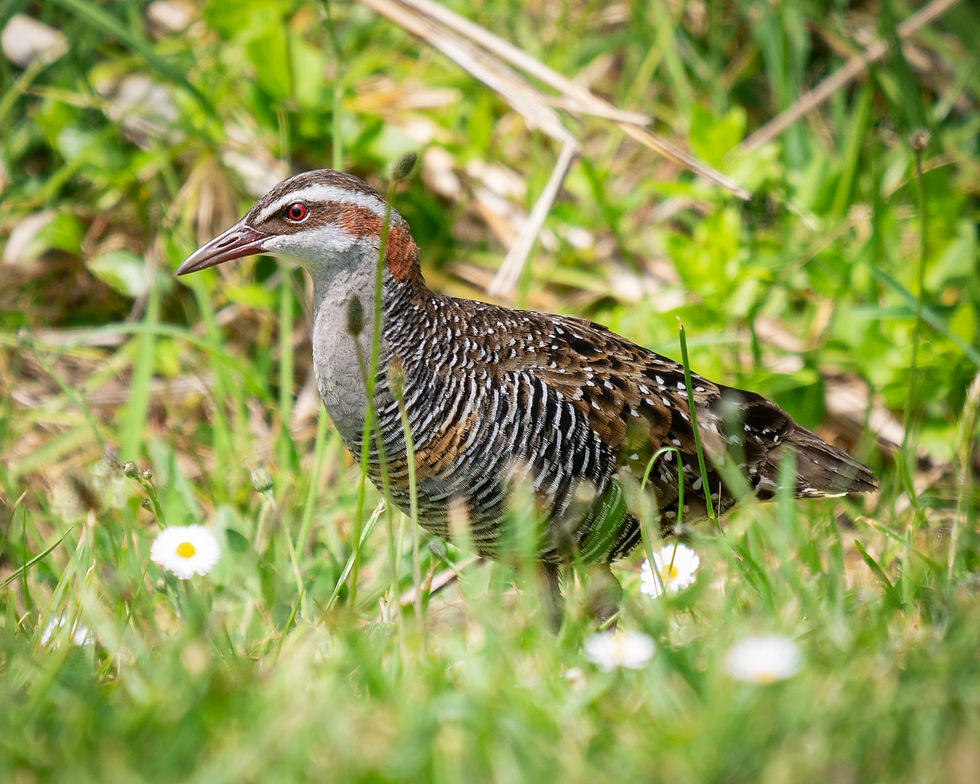
Locally, banded rail can often be seen feeding on open mudflats during mid-low tide periods usually in the early morning and late afternoon. They are regularly sighted above the causeway on the Moana anu anu Estuary and at other sites along the southern and western harbour fringes but rarely wander far out from the cover of their home territories.
Approaches by humans and potential predators result in their rapid disappearance, running swiftly back into the nearby escape cover.
These birds are easily identified by their stalking behaviours while foraging for food, but more often only sighted when moving because of their cryptic colouring that blends them in so well with their habitat. Unlike their cousin the flightless weka, they are strong flyers but are seldom seen flying. It is thought any movement away from their home territories is undertaken under the cover of darkness. Occasional records in Taranaki, Wairarapa and Stewart Island supports their ability to fly long distances.
Pairs remain on their territories year round which they defend aggressively from all other banded rail. Their cup-shaped nests are usually located on or near the ground in dense cover of tall grasses and sedges. Most eggs are laid between September and December and some even later. They probably lay several clutches of 3-6 eggs each season if necessary but are unlikely to successfully rear more than 2 clutches over the course of a breeding season.
On hatching, following 16-26 days of incubation, chicks leave the nest accompanied by both parents. It takes a further 60 days of parental care for chicks to reach the flying stage. Their food consists mainly of snails, crabs, spiders, beetles and worms, but they will also take seeds, small berries and succulent leaves.
It has been posited that mangrove forests are a preferred and essential habitat of banded rail. This theory has been used by some local authorities in the past as one of the reasons to oppose any mangrove control.
Mangroves do not occur naturally in estuarine waters south of Kawhia Harbour on the west coast and Ohope estuary on the east coast of the North Island. The continued existence of healthy populations of banded rail in habitats with no mangroves in these southern parts of the North Island, the South Island and numerous off-shore islands, has unfortunately been ignored up until now.
In addition, research findings have revealed an average territory size of 4ha/pair for banded rails in Northland mangrove habitats and 1.5ha/pair in Nelson saltmarsh habitats.
This further disproves the theory that mangroves are an important component for healthy populations of banded rail. The control of predators is clearly the most important management tool required to ensure the continued survival of this species.
— John Adams, Whangamatā Harbour Care
Photo credit: Corinne Bowie

